Some thoughts on dōjō culture and protocol
The practice of Aikido is deeply rooted in and informed by Japanese culture. This includes, language, manners, dress, philosophy, history and pedagogy. This makes the dōjō an exciting new space to enter but, with that novelty, it may also feel a bit uncomfortable for a first time visitor. Experienced members of the dōjō do not expect beginners to know anything about this culture. They have been through the process of becoming comfortable in the dōjō so, far from being judgemental, they will kindly help newcomers to learn the ropes.
With this in mind, here is some information that may help to introduce you to three aspects of the new world of Aikido, etiquette, language and heirachy.
Etiquette
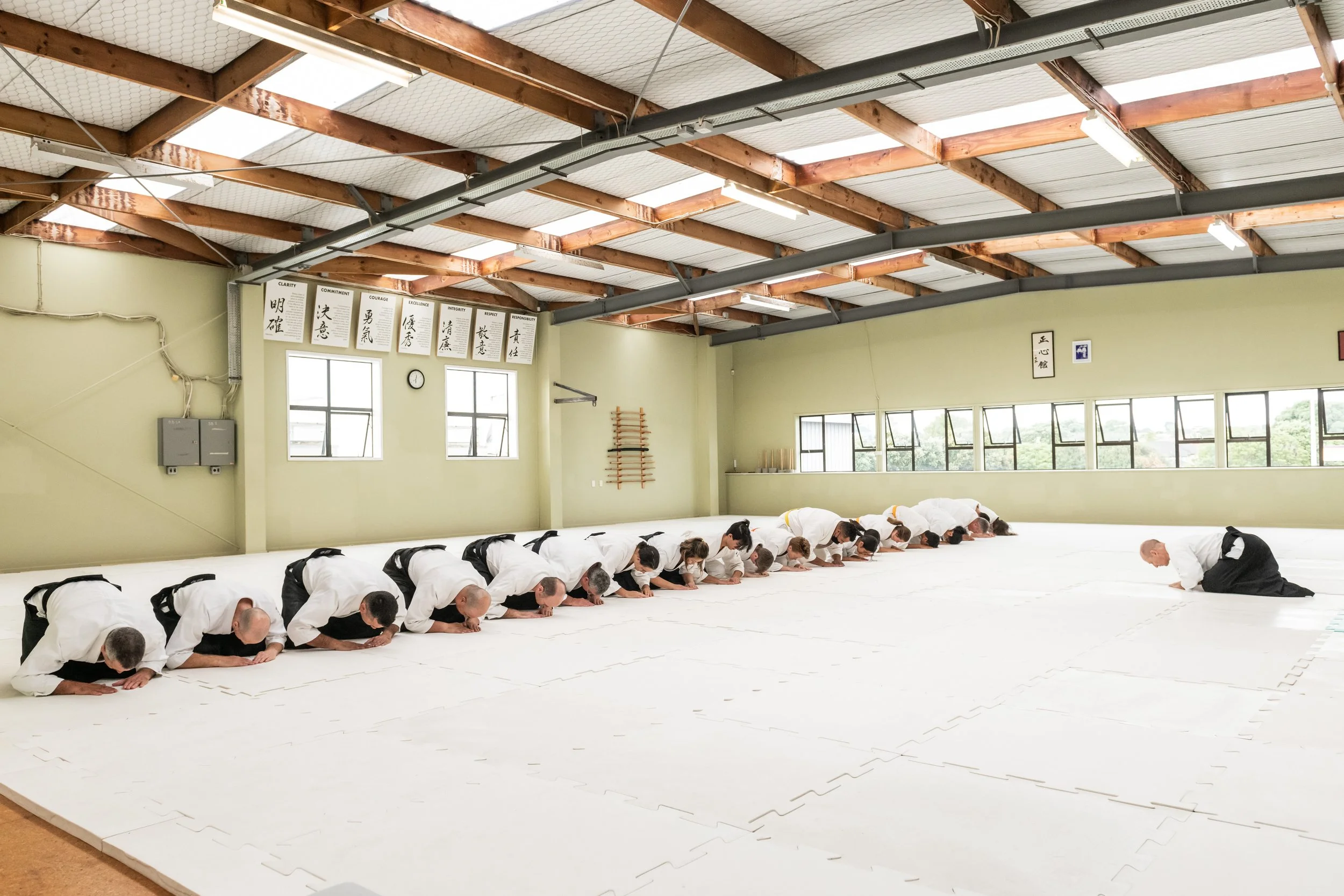
There is a traditional saying that “budō begins and ends with rei” (武道は礼で始まり礼で終わる). Rei means both etiquette and bow. So, you will notice that there is a lot of bowing going on during class. Fundamentally, bowing is about showing respect to others and the space we occupy. Some particular ways bowing supports our practice are;
keeping us considerate of our fellow dōjō members
designating transitions in time, for example the start and end of class
designating transitions in space, for example moving in and out of the training area
designating transitions in activity, for example receiving instruction as opposed to engaging in practice
safety, by creating pauses that focus awareness on other people, environment and equipment
coordinating activities between training partners
developing focus and situational awareness as aspects of a self protection mindset
Language
The international language of Aikido is Japanese. This is primarily seen in the naming of techniques and in terms for specialised concepts and principles. Like etiquette, there is no hurry to learn all these new words. To begin with there are two expressions that will be very useful
onegaishimasu - a direct translation to English is a little awkward but you can think of it as meaning something like “please help me with this”
arigatō gozaimashita - thank you very much (for something that has been completed
It will probably also be useful to learn to count from one to ten;
ichi
ni
san
shi/yon
go
roku
shichi/nana
hachi
kyū
jū
Don’t worry though, the language will become more familiar with time. If you do want to look for a word we have quite an extensive glossary page.
Heirachy
The apparent hierarchy of the dōjō can feel foreign and easily misunderstood. There is a graded structure in the dōjō that applies not just to the members but to the space itself. Coming from modern, egaliterian Aotearoa New Zealand, this can feel uncomfortable. The purpose of the gradation is not to place some students above others. Rather, it is to help everyone recognise who best to seek guidance from and to remind the more experienced of their responsibility in creating a safe place and to support the less experienced. A good way to think of the dōjō community is as a healthy family. Younger members of the family are not less valuable nor less worthy of respect, but they are in a different place in their life’s journey and will require a different sort of care and guidance.
The most obvious way you will recognise these grades are by the belts and dress of the members. You will also notice it in the way members line up at start and end class, arranged from the most experience to the least experienced.
The people on the mat with you are of many different ages and backgrounds and have varied skills and experience outside of the dōjō. They are also warm and welcoming. Outside of class time they are friendly and keen to get to know one another on an even, person to person basis.
Your questions are always welcome
If you want to know more about something you are very welcome to ask the instructor or a senior student. Of course you can search the internet but we would love to answer you in person. Enjoy the new world of Aikido!